
When running is restricted, “just cross-train” is not much of a plan.
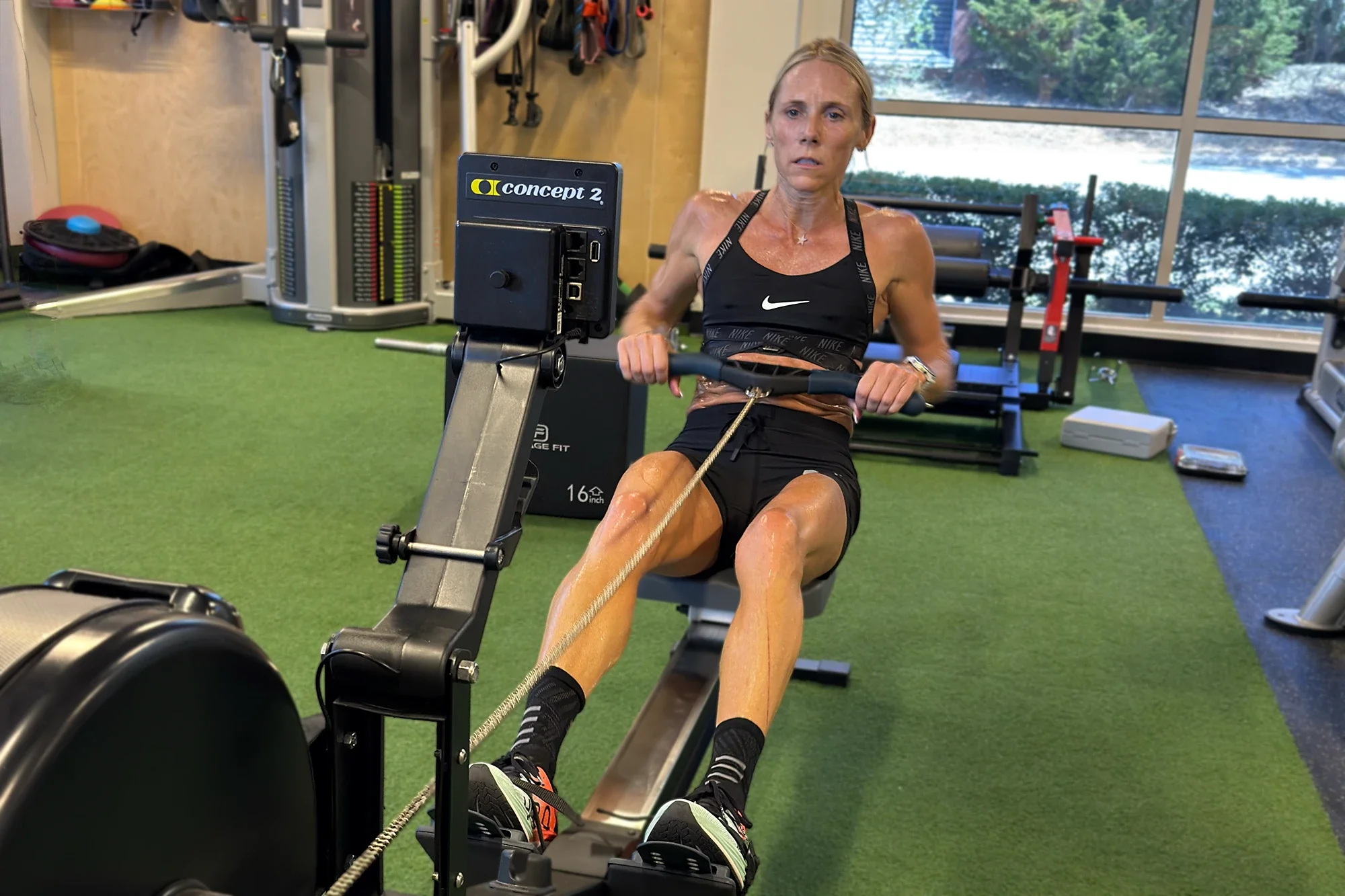
The bike, rower, SkiErg, elliptical, stair climber, and pool can all create useful cardiovascular work. But they are not interchangeable, and the best option depends on what movements you can currently perform, the equipment you have access to, and the type of training session you are trying to build.
No single machine replaces running. Build a small group of movements that fit your current restrictions and let you keep training with purpose.
Preserving Fitness Through Intensity
There is good evidence that fitness begins to change relatively quickly when endurance training stops completely.
A 2022 study of endurance-trained athletes found measurable reductions in VO₂max, exercise time to exhaustion, maximal stroke volume, and knee-extensor strength after two weeks without training. That sounds bad, but there is an important distinction:
Not running doesn’t mean not training.
Research on reduced training consistently shows that athletes can preserve substantial aerobic capacity even when overall training volume falls considerably, particularly when some training intensity is maintained.
A review published in the Journal of Strength and Conditioning Research found that endurance performance could often be maintained despite large reductions in training frequency or volume, provided exercise intensity remained relatively high. The authors concluded that intensity appears to be an especially important variable when the objective is maintenance rather than improvement.
Older experimental work points in the same direction. Reducing training frequency from six sessions per week to as few as two while maintaining session intensity and duration preserved previously developed VO₂max in the subjects studied. Conversely, reducing training intensity produced greater losses in aerobic capacity.
For an injured runner, the practical implication is important: the training week does not automatically have to disappear because regular running is on pause.
It just may need to look very different.
Stop trying to replace miles with miles
One of the easiest mistakes to make is trying to convert every lost running mile into an equivalent amount of something else.
Running miles are not equivalent to other cross-training exercises. Many runners try to translate their weekly runs and weekend long runs into equivalent cross-training sessions: Eight miles becomes 60 minutes on the bike or a long run becomes an extremely long elliptical session.
Running distance is a useful measure when you are running because distance reflects a specific movement performed under relatively consistent mechanical conditions. Once you change your training modality (e.g., rowing instead of running), that relationship breaks down.
Ten miles of running does not have a scientifically precise equivalent in cycling, rowing, aqua jogging, or SkiErg work.
Instead, think about the training stimulus you were trying to create.
Was today supposed to be:
easy aerobic volume?
a threshold session?
high-intensity intervals?
a longer endurance effort?
recovery?
Then choose a cross-training exercise and rebuild the session around that objective.
This is one reason blindly being told to “just bike” can be frustrating for runners. The equipment is only one part of the workout. Duration, intensity, interval structure, recovery, and weekly placement determine what the session actually does.
Keep structure in your training week
When running gets taken away, training can become reactive:
Bike today.
Maybe swim tomorrow.
Take another day off.
Try the rower because someone at the gym suggested it.
Those are a series of activities during the week, but it is not much of a training plan. A better approach is to preserve the architecture of training wherever your restrictions and recovery allow it.
If Tuesday was your quality day, Tuesday can still have that role using another exercise. If Saturday was your longer aerobic day, it can still be the longer aerobic day. The exact frequency or volume may need to change, but retaining a planned week gives each session a purpose.
It also helps avoid the opposite problem: trying to compensate for lost running by turning every cross-training session into a sufferfest.
Hard training still creates fatigue, whether it comes from running shoes, bike pedals, rowing handles, or a SkiErg.
Measure effort differently
One complication is that familiar running metrics do not always transfer cleanly to another exercise.
Running pace does not equal cycling pace. Heart rate may not equate between different exercises either.
For example, in experienced triathletes, heart rate at anaerobic threshold averaged only about 3 beats per minute lower on the bike than on the treadmill, but the agreement for individual athletes was poor. The researchers concluded that directly transferring heart-rate training zones between running and cycling had limited practical value. Your normal running zone should not automatically become your bike zone.
The same general issue appears when switching among bikes, rowers, SkiErgs, ellipticals, and running.
This is why rating of perceived exertion (RPE) becomes useful. Instead of asking whether you are hitting your normal running pace, ask what the session should feel like:
Easy aerobic work should feel easy.
Threshold-style work should feel controlled but difficult.
Short high-intensity intervals should feel genuinely hard.
The numbers can still help, particularly once you establish exercise-specific benchmarks. But effort is often the better starting point than pretending your running metrics transfer perfectly.
A simple way to choose
Start with three questions:
What movements and loading are currently allowed?
What training stimulus are you trying to create today?
Which option lets you create that training stimulus without exceeding those guardrails?
That is usually more useful than asking which cross-training machine is “best.”
If you want examples of how these movements can be used in complete sessions, RunReserve’s Free Workouts include structured cross-training workouts, while the Cardio Library shows examples of modified cardio movements around different training constraints.
References
Carey DG, Tofte C, Pliego GJ, Raymond RL. Transferability of running and cycling training zones in triathletes: implications for steady-state exercise. Journal of Strength and Conditioning Research. 2009.
Bosch AN, Flanagan KC, Eken MM, et al. Physiological and Metabolic Responses to Exercise on Treadmill, Elliptical Trainer, and Stepper: Practical Implications for Training. International Journal of Sport Nutrition and Exercise Metabolism. 2021.
RunReserve note
RunReserve provides training and fitness programming and does not diagnose injuries or replace medical care. Follow the restrictions and return-to-activity guidance provided by your physician, physical therapist, or other qualified healthcare professional.